
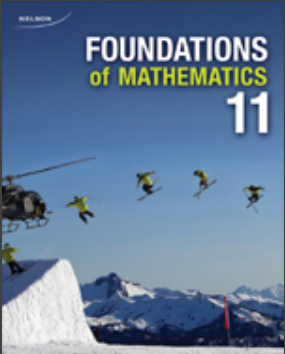
Foundations Math 11 Textbook
You may be interested in downloading a graphing Calculator Emulator for use in this course. This is like having a graphing calculator on your computer (and like I use in my videos!). Click the button below to check out this emulator!
Chapter 1 – Inductive and Deductive Reasoning
Homework:
1.1 Pg 12 # 1–6, 9-11, 16
1.2 Pg 17 #1-3
1.3 Pg 22 # 1 – 9 odd, 15, 17
1.4 Pg 31 # 1,3,5,7,9,12,17
1.5 Pg 42 # 1 – 7
1.6 Pg 48 # 1-3,6-8,9,11
1.7 Pg 55 # 1-5,9,11
Review Pg 61 Choose any 10 questions
- FM 20 1.1 Making Conjectures Inductive Reasoning (Lesson 2018)
- Foundations of Math 20 (FM 20) 1.1 #1-3 Home Work Questions
- FM 20 1.2 Exploring Validity of Conjectures (MM Lesson 2026)
- FM 20 1.2 Validity of Conjectures – Lesson 2025
- FM 20 1.2 /1.3 Exploring Validity of Conjectures and Counterexamples COMBINED LESSON
- FM 20 1.6 Using Reasoning to Solve Problems (MM Lesson)
- FM 20 1.6 Reasoning To Solve Problems Inductive and Deductive Reasoning
- FM 20 1.7 Reasoning in Games and Puzzles (MM Lesson)
- FM 20 1.7 Analyzing Puzzles and Games
Chapter 2 – Properties of Angles and Triangles
2.1 pg72 #1,2,4,5,6
2.2 Pg 78 # 1,2,3,4,10,12, 15, 20
2.3 Pg 90 # 1 – 6,11,15
2.4 Pg 99 # 1 – 4, 6,7,12,16
Handout / (Alt: Review Pg 106 #1-10)
- FM 20 2.1 – 2.2 Angles and Parallel Lines (MM Lesson)
- FM 20 2.1 Exploring Parallel Lines
- FM 20 2.2 Angles Formed by Parallel Lines
Chapter 3 – Acute Triangle Geometry
3.1 #1, 2, 5
3.2 #1, 2, 3def, 4, 11, 13
3.3 #1, 2, 3, 4, 5, 6, 10, 13(opt)
3.4 #1-5, 10
Review – #1-12 p.154
Chapter 4 – Oblique Triangle Geometry
4.1 #1-4
4.2 #1, 2, 3ab, 4ab, 9, 14
4.3 #1 – 5, 9, 15
4.4 #2, 3, 6, 11
Review p. 200 #1-8
- FM 20 4.2 Sin and Cosine Law for Obtuse Triangles 2024
- FM 20 4.2 Sine and Cosine Law for Obtuse Triangles
Chapter 5 – Statistical Reasoning
5.1 #1, 2
5.2 #1, 3, 4, 6
5.3 #1ac, 2, 6 (use formula, show work), #5, 10, 13 (May use graphing technology)
5.4 #1-3, 6, 10
5.5 #1ad, 3, 4ad, 10, 13 OR 17
5.6 #1, 3, 6, 9
Review: Choose 10 out of 12 Questions (at least one question from each section)
- FM 20 5.6 Margin of Error, Confidence Intervals and Levels Lesson 2024
- FM 20 5.6 Confidence Intervals
Chapter 6 – Systems of Linear Inequalities
6.1 #2-5, 8, choose 10 or 12
6.2 #1, 2
6.3 (Part 1)#1, 3a, 4a, 10
6.3 (Part 2) #2, 3c, 6, 8, 12
6.4 #1, 3, 7
6.5 #1-3
6.6 #1, 2, 8, 13
Ch 6 review p. 349 # 2, 3, 6, 7, 11
- FM 20 6.1 Graphing Linear Inequalities in Two Variables
- Graphing Inequalities – Boundary Line Types Explained
- FM 20 6.2 Exploring Graphs of Linear Inequalities Lesson (2018)
- FM 20 6.2 and 6.3 Systems of Linear Inequalities (#1of2)
- FM 20 6.3 (#2of2) Creating Graphs of Systems of Inequalities
- FM 20 6.6 Linear Programming
- FM 20 How to Determine Boundary Line Equations given graph of System of Inequalities
Chapter 7 – Quadratic Functions and Equations
7.1 #1-6
7.2 #1,3,5,14
7.3 #1, 3, 4, 6ac, 8ac, 9, 15(optional)
7.4 #1-4, 8, 11
7.5 #1-4, 7, 13
7.6 #1-5, 13
7.7 #2-4, 6, 8, 13(optional)
7.8 #1, 2, 4, 8
Review p. 443 #1, 2, 4-9, 11-15
Factoring Practice – questions to be assigned in class from package below
- FM 20 7.4 Factored Form of a Quadratic Equation (2018)
- FM 20 7.4 Determining Quadratic Equation of Parabola from Graph Example
- MOST IMPORTANT MATH SKILL! Foundations Math 20 (FM 20) 7.5 Solving Quadratic Equations by FACTORING!
Chapter 8 – Proportional Reasoning
8.1 #1-13
8.2 #1-8,13,15
Mid Ch Review p. 473 #1-6, 9
Quiz 8.1-8.2
8.3 #1-6, 11, 13, 17
8.4 #3, 4, 6, 13
8.5 #1, 2, 3, 5, 7, 11, 13, 15, 17, 19(opt), 20(opt)
8.6 #1-7, choose one from 11-20
Review asn’t – p. 515 Choose 2 questions from each section of the review asn’t (12 questions total)
- FM 20 8.3 Scale Diagrams Lesson 2025
- FM 20 8.3 Scale Diagrams (Lesson 2018)
- FM 20 8.4 Area relationships of 2-D shapes (Scale Factor squared) Lesson 2025
- FM 20 8.4 Scale Factors and Areas of 2-D Shapes (Lesson 2018)
- FM 20 8.5 Similar Objects, Scale Models and Scale Diagrams
- FM 20 8.5-8.6 Scale factor and Volumes of 3-D objects (Combined Lesson 2025)
- FM 20 8.6 Scale Factors and 3-D Objects
- FM 20 Ch. 8 Review
Project
Foundations of Math FM20.1
Demonstrate understanding of the mathematics involved in an historical event or an area of interest.
[C, CN, ME, PS, R, T, V]
Indicators for this outcome
| (a) | Develop a rubric or other scoring schema for the assessment of the research and presentation. |
| (b) | Collect primary or secondary data (quantitative or qualitative) related to the topic. |
| (c) | Assess the accuracy, reliability, and relevance of the primary or secondary data (quantitative/qualitative) collected by:identifying examples of bias and points of viewidentifying and describing the data collection methodsdetermining whether or not the data are relevantdetermining whether or not the data are consistent with information obtained from other sources on the same topic. |
| (d) | Interpret data, using statistical methods if applicable. |
| (e) | Identify controversial issues, if any, and present multiple sides of the issues with supporting data. |
| (f) | Organize and create a presentation (oral, written, multimedia, etc.) of the research findings and conclusions. |
Project Ideas for ‘primary data collection’
Primary Data collection and analysis often presents students with a more engaging and hands on approach to Math projects. Although some secondary data collection may provide insight into interesting topics and involve high level, focused information, collecting primary data allows students to be more involved in the process of actual scientific discovery and analysis. If you want to urge your students to consider more primary data collection for your project, consider some of the ideas below. If you have more ideas I’d love to hear about them. Email me at [email protected]
- Compare gas prices for the month of April or May for 4 different gas stations in your area (maybe this doesn’t work in small centers), analyze the change in prices factoring at least 4 different possible reasons for the changes.
- Collect speed data over lunch hour in your school zone (if you have a radar set up) and analyze the patterns and give 4 factors that may influence the patterns.
- Draw sketches and record dates and times along with specific temperature, pressure, etc conditions for the germination of a seed. Give three reasons for the patterns you see and discuss 3 changes in the conditions or seed nature that may affect germination data (beware, start this one early).
- Survey your school for hours of homework per day, hours of sleep per night, grade average, extracurricular involvement, etc. Determine what factors make students successful, happy, and fulfilled. Generate conclusions based on the data you’ve collected – be prepared to share with the class.
These are just a few suggestions.
Final Exam Preparation
The following questions from the text are recommended for your own preparation for the final exam and will prepare you well for the final.
Ch 1-2 p. 110 #1-13
Ch 3-5 p. 287 #1-14
Ch 6-8 p. 520 #1-14
You may also be interested in this final review asn’t that includes answers. Follow the link below
Final Course Review with Answers